 It’s a privilege to be part of Nebraska Cures and its critical mission to promote, support, and advocate for scientific research and education. This work is more important now than ever. The goal—that society not only understands but embraces the importance of science—is something I believe in wholeheartedly.
It is undeniable how turbulent this moment is for science, I would even say that as scientists we are in a precarious position. We’re living in a time when facts are questioned or simply canceled, expertise is often dismissed and replaced by dogma, and science itself is under siege. And yet, this moment is also filled with opportunity—this requires us to focus on how we educate, inspire, and prepare the next generation.
My own journey with science is a love story —how I instantly was excited by the possibilities, then as happens in love, I drifted away from it not straying too far into medicine and ultimately returned to a full armed embrace of a career in science. There were pivotal experiences in early life that shaped my passion for science, and I hope that they these might inspire you to think about your own influence—especially how you can help young people find their path in science.
Growing up in Wyoming in the 1980s, science was woven into our elementary education in a very hands-on curriculum. Science fairs were an annual school event, a day long affair, starting in third grade. I remember the excitement of developing a question, testing it, explaining it—then having an opportunity to present my work and answer questions from the judges. That was powerful. Another powerful memory was the all school assembly where the winners of the fair were announced. Science was celebrated as much as a football or basketball championship. I was hooked and participated every year from 3rd to 12th grade.
With such a powerful science experience in public school, including fully equipped science labs for biology, chemistry, and physics, there was no doubt in my mind that I would major in a science, and have a career in research. Upon arriving at college, I was lucky to have mentors who opened the door to a state-of-the-art lab experience in my very first year. That access, that trust—it made me feel welcomed and included, like I belonged in science. I knew I could contribute and that my work would be meaningful.
But then came the realization that, even in the 1990’s getting funding for research was hard, and there were few opportunities to work in academia in my rural state. What was needed were medical doctors, so off I went to medical school and residency, where the emphasis shifted. My career would be science adjacent; I could implement the breakthroughs that others discovered. In my medical training I found few opportunities for research. And slowly, I stopped thinking of myself as a scientist. That was a major shift—one that I didn’t even realize was happening at the time.
In fellowship, I once again thrived in a research environment when dedicated time for research was available and required for board eligibility. I remembered how much I loved asking questions— my curiosity never went away. It was just waiting to be invited back in. I worry that pediatric fellowships no longer have a research requirement and wonder how many potential scientists miss their calling due to lack of this opportunity to focus solely on being curious.
Unfortunately, as I began my early career as a physician, I received a clear message that too many young women still hear: “You can’t be a physician, a scientist and a mom.” That was disheartening—but was a voice so loud that for a time I believed that message. But my curiosity and love for science were louder. As a clinical faculty member I enrolled in and completed a PhD program and started asking questions that were important to my patients, and I started discovering not only answers, but more questions.
Curiosity and formal research training had allowed me to come full circle and combine my passions for science and the care of critically ill preterm infants. I had never been clearer about my path forward.
And I knew I had a role to play in making sure the next generation of young women would not hear the message I heard. If you have passion and are willing to be curious you can be an amazing physician, scientist and mom. You don’t have to step back and be less than you want to be.
Because the truth is: we can’t afford to lose curious minds to doubt or discouragement. We need people—especially young people—to understand science, to participate in science, and to see themselves in careers that move knowledge forward and challenge what is currently known. Challenge knowledge not because it doesn’t serve your agenda but challenge current knowledge in a manner that allows us as a society to know more, heal more patients, prevent more disease. We all can collectively be so much more if we embrace scientific advancements.
That’s why mentorship and pipeline development are so critical—not just for the future of research, but for the future of a science-literate society. We need young people to see that science is not some distant, elite world. It’s a space they belong in. A space where their questions matter.
I am lucky to run a lab that keeps busy training the best and the brightest at UNMC.
Today, one of the most satisfying parts of my role is mentorship. I get to help create programs that open doors—programs with Girls Inc. Omaha, North Star, and Completely Kids. These initiatives give young people, especially those who are traditionally underrepresented in science, a chance to explore, experiment, and believe in their potential.
Because when we invest in these kids, we invest in a future where science is not only understood and accepted—but loved.
Science can unlock the incredible potential of the next generation, and they will unlock so much more with science.
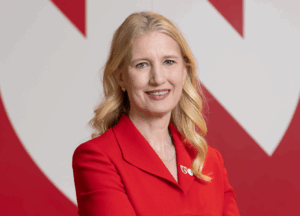
Ann Anderson Berry, MD, PhD, is the