
UNO researchers are reinventing combat footwear with the “FlyBand ExoBoot” designed to prevent ankle injuries and speed recovery.
Ankle sprains keep U.S. military service members on the sidelines a combined 6 million days each year. University of Nebraska at Omaha (UNO) researchers are working to change that.
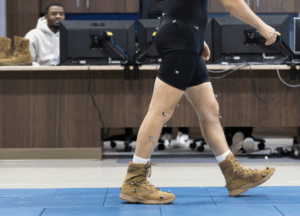 What’s new
UNO Biomechanics researchers are testing the FlyBand® ExoBoot, an exoskeleton embedded inside a regulation combat boot invented by Connecticut-based company, Motive Labs.
With no motors or batteries, this innovative system uses carbon-fiber “stability cartridges” to deliver customizable ankle support for injury recovery and prevention.
Why it matters
Each year, musculoskeletal injuries cost U.S. military personnel an estimated 25 million limited-duty days. Lateral ankle sprains alone contribute up to 6 million of those days, many of them preventable.
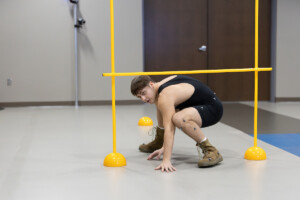 The FlyBand ExoBoot aims to cut those numbers by helping service members recover faster and avoid re-injury, all while maintaining natural movement and mobility.
Lab tests at UNO show the prototype rivals the standard of care of current boots-plus-ankle-brace combinations for inversion control while offering the lowest resistance to natural walking motions.
If successful, the design will be relevant in a wide range of footwear, from hiking boots, to work boots, to high-top basketball sneakers
Zoom in
The boot’s stiffness can be fine-tuned using interchangeable cartridges.
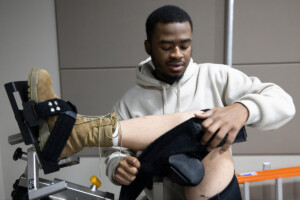 It supports lateral movement without restricting forward motion, unlike traditional braces, increasing the ability for ligaments to heal.
A spring-like “exotendon” helps reduce energy demand by up to 11% during walking.
Lab tests show performance that matches or exceeds conventional brace-boot combos.
It’s also the first military footwear to incorporate a female-specific anatomical design.
What’s next
A new lab study is underway and enrolling 20 service members with chronic ankle instability, followed by a six-week take-home trial using smart sensor instrumentation.
The research team plans to apply for a full Clinical Trial Award from the U.S. Department of Defense’s Congressionally Directed Medical Research Programs (CDMRP).
What they’re saying
Sara Myers, Ph.D., Biomechanics Professor, Associate Vice Chancellor for Research and Creative Activity, and the study’s principal investigator: “This is exactly the kind of research UNO was built to do: community-engaged, mission-driven, and focused on real-world impact. We’re proud to be collaborating on a project that not only advances science, but also directly improves the health and readiness of those who serve.”
Adam Rosen, Ph.D., Director of the UNO School of Health and Kinesiology and the study’s co-principal investigator: “Reducing ankle injury risk for service members is important as ankle injuries are among the leading causes of decreased physical impairment and function in active populations. The FlyBand ExoBoot’s ability to provide personalized, responsive support could also improve care for athletes, first responders, and anyone recovering from an ankle injury.”
Mark Roser, Founder of Motive Labs: “Working with UNO has been a game-changer. Their biomechanics expertise and collaborative spirit pushed our design further than we imagined. Together, we’ve created a platform for innovation that bridges science and service.”
Grant information
Funding source: U.S. Department of Defense-Congressionally Directed Medical Research Programs
Award number: Department of Defense, U.S. Army Medical Research and Development Command, Congressionally Directed Medical Research Programs 94252410917.
Title: Increasing Soft Tissue Remodeling After Lateral Ankle Sprain by Deploying Exoskeleton-Integrated Boots to Support Longer-Term Rehabilitation Protocols in Return to Duty.
– Originally posted by UNO, August 06, 2025.