
Nebraska Women in STEM talked to wildlife biologist Elsa Forsberg about her passion for protecting endangered species and what a career in wildlife biology really looks like.
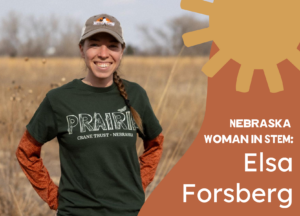 Elsa Forsberg lies covered in grass in a wet meadow in the middle of March, waiting. She holds her breath as five, then ten, then hundreds of four-foot-tall gray birds land in the water just feet from her hiding place. As they start to forage in the murky water, she freezes as one bird begins to flap its wings and jump: a tell-tale sign that a crane has stepped in a meticulously placed snare line.
Capturing this crane is part of a project to better understand Sandhill crane movements in the Central Platte River Valley and protect the species. Elsa and a team of two other biologists collect data, place a GPS tracker on the crane, and let it go.
Elsa is a wildlife biologist with the Crane Trust, a nonprofit conservation group located along the Platte River in central Nebraska. Her day-to-day duties include conducting wildlife surveys (from frogs to rodents to birds), analyzing data, and helping to document and protect the Platte River ecosystem. Her passion is to protect threatened and endangered species.
“I wanted to do something with my career that would be my way to make a difference in the world, and there’s a lot of ways you can do that, but I got really literal about it, I guess!” Elsa said.