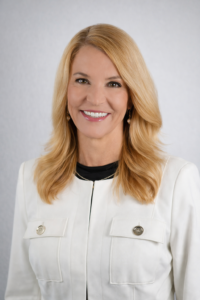
 Dr. Andrea Holmes has been passionate about science since high school. Curious about how molecules make up the natural world, she delved into organic chemistry because it “connects structure, function, and real-world applications.” Growing up in Germany, Dr. Holmes was inspired by the country’s rich history of chemistry and become especially interested in how chemistry can be used to solve complex problems in health care, plant science, and beyond.
Since joining the chemistry department at Doane University in Crete, Nebraska, in 2005, Dr. Holmes has contributed to both innovative research and student success. She has helped strengthen the chemistry department through more than $5 million in federal grants, including support from the Presidential Early Career Award. Her research spans a wide range of topics, including drug detection methods using nanotechnology, sensor design, nanohybrid research, and biofilm prevention using synthetic materials.
Nanotechnology and biofilms interested Dr. Holmes because both fields “show how small-scale interactions can have major health and environmental consequences.” She emphasizes that biofilms are especially important because they can drastically affect many different aspects of life, like medical devices and water systems.
Biofilms are complex communities of microorganisms that live within a protective matrix. This matrix helps shield bacteria from harsh environments and even the body’s immune system, making infections more difficult to treat. Biofilms can affect healing after implants or joint replacements, contribute to hospital-acquired infections, and even form the plaque on your teeth.
Dr. Holmes has worked on the synthesis of polymetric surfaces in her own lab, finding that the growth rate of biofilms on the material synthesized in her lab, called slippery BMA-EDMA, was slower than other materials. This finding could help to slow or prevent biofilm infections in implants if this material is used as a coating for the device.
Dr. Holmes investigated biofilms through the Center for Undergraduate Research on Biofilms (CURB) at Doane University. This NIH-INBRE funded collaboration was made up of four Doane researchers working with Undergraduate students seeking to research biofilms from many different viewpoints.
While Dr. Holmes enjoys the discovery process and finding practical solutions to real-world problems, she says mentoring students has become one of the most rewarding parts of her career. On working with students, she says “the most rewarding part is watching students become confident scientists.”
Dr. Holmes participated in partnerships with the Karlsruhe Institute of Technology and in the INBRE Scholar Program to promote student research. Dr. Holmes believes that hands-on research experience changes how someone understands science, teaching creativity and critical thinking that cannot be learned in the classroom. Dr. Holmes says that research opportunities show students that they belong in science and can contribute to solving real-world problems.
Since 2023, Dr. Holmes has been the coordinator of the online Doane University chemistry courses. She and her chemistry colleagues develop and teach modern, cutting-edge curriculum in chemistry with hands-on experiential lab experiments for pre-health professional students who want to enter the medical field as physicians, nurses, PAs, dentists, or other health related professions that require chemistry courses as a pre-requisite for their programs.
For Nebraskans, Dr. Holmes’ research impacts how disease development can be slowed and how healing from disease can be improved. Her work could also affect the way that hospital-acquired infections are treated and prevented. She believes that funding research is “an investment in healthier communities.” Her work is invaluable to patients and the field of healthcare, not only advancing technology but also promoting new scientists and researchers in Nebraska through her mentorship.
– Written by Alexandra Williams