
 For many people, social media has become an everyday source of health information. A quick scroll through TikTok or Instagram can expose users to medical advice, preventative care recommendations, mental health discussions, and misinformation. But as social media becomes increasingly woven into how people learn about their health, an important question remains: How do these messages influence what people believe—and the decisions they make?
For Ciera Kirkpatrick, an assistant professor of advertising and public relations at the University of Nebraska–Lincoln’s College of Journalism and Mass Communications, answering that question means looking at the intersection of strategic communication, social media and public health.
Kirkpatrick’s research examines how media messages influence people’s mental and physical health, including how the content and structure of a message interact with characteristics of the audience to shape perceptions, emotions and health behaviors. Her interest in this work is also personal. During the COVID-19 pandemic, Kirkpatrick was navigating the transition to motherhood while spending more time online.
 “I had a baby in 2020,” Kirkpatrick said. “I got to experience becoming a parent during the COVID pandemic.”
As a new mother during a time of social isolation, Kirkpatrick began noticing how social media affected her own mental health. The experience helped bring together her background in strategic communication and her interest in health.
“I kind of wanted to combine all of that together and make a career out of studying that,” she said.
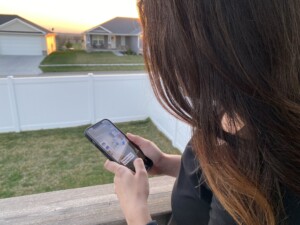
That combination of communication and health is particularly evident in Kirkpatrick’s research on TikTok and young women’s use of social media for health information. Her research found that nearly all participants had encountered health information on TikTok, whether they intentionally searched for it or simply came across it while scrolling.
“People are getting health information from the platform,” Kirkpatrick said. “So that’s huge.”
For public health professionals, that finding represents an opportunity: people are already online, and health professionals can meet them where they are. But Kirkpatrick’s research also revealed a more complicated problem. While most participants agreed that misinformation was a problem on social media, far fewer believed they had personally encountered health misinformation.
Kirkpatrick described this as the “third-person effect”—the idea that people recognize a problem but believe it affects other people more than themselves. The result is a troubling possibility: people may be exposed to misinformation without realizing it.
 That challenge becomes even more significant when considering how health messages are designed. In one study, Kirkpatrick examined TikTok content related to cervical cancer screening and Pap tests. She found that the same visual could have very different effects depending on the message surrounding it.
When a medical tool used during a Pap test was shown alongside information about what the procedure involves and why screening is important, the message was effective. However, when the same visual was paired with discussion about potential pain or discomfort, the message could actually discourage women from wanting to be screened.
“When they talked about overcoming pain while showing the speculum, that was the most harmful message,” Kirkpatrick explained.
The finding illustrates a central lesson from her research: good intentions do not always guarantee good outcomes. A health professional may be trying to reduce someone’s fear by explaining how to manage discomfort, but the message itself can unintentionally introduce fear that was not there before.
“All of these different factors come together to have effects,” Kirkpatrick said. “Getting to have a better understanding of how things work together can help us to be more strategic and effective with our messaging.”
The complexity does not end with the message itself. Social media algorithms also influence the health information people encounter. Kirkpatrick explained that algorithms can create an echo chamber by repeatedly showing users content similar to what they have already watched or engaged with.
“If you engage with a video about a certain topic, for instance, then the algorithm feeds you more of what you’ve already engaged with,” she said.
Content that is controversial, emotional, or shocking may receive more engagement, making it more likely to be shown to additional users. Over time, this can distort a person’s perception of how common or important an issue actually is.
“Ultimately, it really kind of distorts your perception of how important something is or how popular something is,” Kirkpatrick said.
For public health professionals, these findings highlight the importance of being intentional about how health information is communicated online. Kirkpatrick believes social media is an important tool for reaching audiences, but simply posting accurate information is not enough.
“People are on social media,” she said. “This is a place that we should be using.”
Effective communication requires capturing attention, establishing credibility and making evidence easy to access. It also requires understanding the audience—what they already believe, what they know and how they might respond to a particular message.
As social media, algorithms and artificial intelligence continue to evolve, Kirkpatrick believes researchers and public health professionals must continue exploring how people determine what information they can trust while also considering how to protect users from the potential harms of social media.
“We need to figure out how we can help people to benefit from the pros of social media while also protecting themselves from the harms,” she said.
Ultimately, Kirkpatrick’s research demonstrates that effective health communication is about more than delivering accurate information. It is about understanding the message, the audience and the technology delivering it—and recognizing how all three work together to influence the way people think, feel and act. In a world where a single scroll can shape what someone believes about their health, that understanding may be more important than ever.
– Written by Haidyn Warner