For Stephanie Limaye, the path to scientific research began with a high school experiment involving door handles and petri dishes.
For Abigail Keating, it came after years of playing saxophone and wondering whether music was really the career she wanted.
Their paths were different, but both students found something they wanted to pursue through undergraduate research—and both were recognized this year with a Nebraska Cures’ Holland Future Scientist Award.
Stephanie Limaye
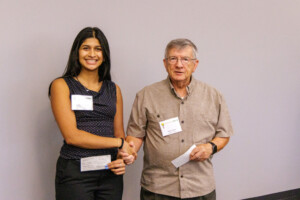 Creighton University senior neuroscience major Stephani Limaye first became interested in research after taking a medical immunology class in high school.
The class was fairly simple. Students swabbed surfaces around their school and grew the samples in petri dishes. Limaye loved the experience.
“I really liked it,” she said.
When she arrived at Creighton, Limaye knew she wanted to continue doing research. She found her way to Dr. Lynne Dieckman’s biochemistry lab through a teaching assistant who worked there. Limaye began working in the lab during the spring semester of her freshman year and has continued ever since.
Her research focuses on how cells control which genes are turned on and off. Limaye’s project explored a possible interaction between two proteins involved in that process. She used an AI-generated prediction as a starting point, then worked to determine whether the interaction actually exists.
The research has also helped Limaye discover that she enjoys the process of scientific inquiry itself.
“The reward isn’t really the end product in this. It’s the journey,” she said.
Limaye has also found value in the opportunities to communicate her research beyond her own laboratory. Through her research experiences and the IMBRE program, she has had opportunities to learn about different areas of research and ways to communicate scientific ideas to different audiences.
That experience came into focus at the INBRE conference, where Limaye placed first in the poster presentation competition.
She said poster presentations have always been more challenging for her than oral presentations because they require researchers to adjust their explanation depending on who is standing in front of them.
“Being able to jump around in your research taught me that I do know what I’m talking about,” Limaye said.
The recognition was particularly meaningful because Limaye had chosen to remain at Creighton for another year rather than move to a larger institution. Her lab was preparing data for publication, and she wanted to see that work through. The poster represented the culmination of months of refining the research and preparing it to be shared.
“The poster was kind of like the bow on the present,” she said.
Limaye plans to take a gap year after graduation before applying to MD-PhD programs. She hopes to continue gaining research experience along the way.
Abigail Keating
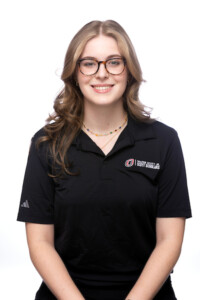
Keating’s route to research was less direct.
The Papillion native spent years playing saxophone and once thought music might be her career. But a biomedical program at Papillion La Vista South High School introduced her to laboratory and forensic science, and she quickly discovered another interest.
Now a junior at the University of Nebraska at Omaha, Keating is majoring in molecular and biomedical biology and chemistry, with a minor in Spanish. She hopes to pursue a master’s degree or PhD and is considering a future in immunology, infectious disease or autoimmune research.
At the heart of that interest is curiosity.
“Deep down, I’m just a really curious person,” Keating said. “I like understanding how things work, especially the human body and how we fight off diseases.”
Keating learned about undergraduate research opportunities through UNO’s Scott Scholars program. When she first heard about INBRE, she was surprised that she could participate in research that could potentially help people while she was still in college.
“I was starstruck that I could do actual research that might help people while I was still in college,” she said. “I thought you needed a PhD to do research.”
Keating’s research focused on pancreatic cancer and the complement system, a part of the immune system made up of proteins found in the blood. She examined the expression of those proteins in pancreatic cancer samples and in precursor lesions, exploring whether they could eventually help researchers identify the disease earlier.
For Keating, one of the most valuable parts of the INBRE experience has been the opportunity to see research outside her own area of study. Although her lab work centered on cancer, the conference exposed her to research in areas including public health and biomechanics.
“I really enjoyed getting to see other people’s work and expand my boundaries,” she said.
Keating was surprised when she learned she had placed first in the oral presentation competition and received a Holland Future Scientist Award. The recognition was validating, she said, because of the amount of effort she had put into her research.
“I was able to show people that I worked hard,” Keating said.
For both Limaye and Keating, the Holland Future Scientist Award represents more than recognition for a successful presentation. It is a reminder that their work matters—and that they are finding their place in science.
And for two students who arrived at research from very different starting points, that may be one of the most valuable discoveries of all.
Learn about the rest of the Holland Future Scientist Awardees here.