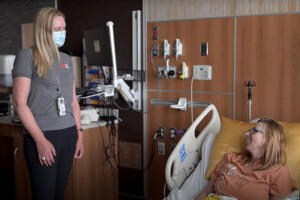
 When the numbness in her toes crept up the right side of her body, Jan Janisch-Hanzlik called her primary care doctor.
The now-49-year-old had been having unusual symptoms for years, but usually by the time she got to a doctor, they were unable to find a cause. This time, her doctor got her to a neurologist the same day. Soon after, she was diagnosed with multiple sclerosis.
She started on medications, but within three months, her condition had advanced to the point that she could no longer drive. She moved from the Elkhorn area to a new more-accessible home in Blair after falling multiple times. She was referred to Dr. Rana Zabad, a neurologist and MS specialist with Nebraska Medicine. About a year ago, her MS started to progress quickly, and Zabad presented her with a new option.
On June 9, Janisch-Hanzlik became what Zabad and fellow Nebraska Medicine researchers believe to be the first in the world to receive allogeneic CAR T-cell therapy, meaning it used cells derived from healthy donors, for treatment of MS as part of a first-of-its-kind clinical trial.
Janisch-Hanzlik, who posts about her condition and the therapy on a Facebook page called MS with Moxie, said Tuesday that her gait has improved since her infusion and she no longer requires a two- or three-hour nap every day. She recently got out and did a little gardening, waiting for cool days since Zabad had cautioned her about being out in the heat.
“It’s exciting,” she said. “I wanted to do it, not just for me, but really for the whole MS population.”
Dr. Matthew Lunning, medical director of the gene and cellular therapy program at Nebraska Medicine, said doctors at the medical center have used CAR T-cell therapy to treat hundreds of lymphoma and leukemia patients since the late 2010s. In those cases, patients’ own T cells, a type of immune cell, are removed from their bodies and genetically engineered to recognize and attack cancerous B cells. B cells are another type of immune cell that makes antibodies and fights infections. The therapy has proved to be a powerful tool against lymphomas and acute leukemias, said Lunning, who specializes in CAR T.
But there is growing hope, he said, that the therapy can do more than treat patients with blood cancers like leukemia and lymphoma. Last summer, he and his team provided the first allogeneic, or donor-sourced, CAR T-cell therapy to a patient with hard-to-treat lupus. The Omaha woman, a mother with twins, continues to do well. He since has treated another lupus patient, and four others have received the therapy at the University of Minnesota.
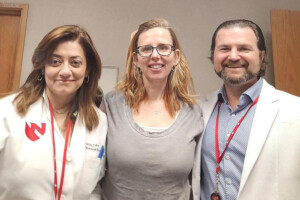 “I think this is a monumental day,” Lunning said.
Zabad said what’s exciting about CAR T-cell therapy is that it could potentially address an important gap in treatment for progressive MS. While other therapies are very effective in controlling inflammation associated with the condition outside the central nervous system, including the brain and spinal cord, CAR T can enter those spaces and offers hope that doctors may be able one day to address that gap.
“This is a completely novel concept in MS therapy,” Zabad said in a statement. “This trial is about pushing boundaries carefully and thoughtfully to explore what could be possible.”
In MS, the immune system attacks the protective sheath — known as myelin — that covers nerve fibers. Like shorts in an electrical wire, the lesions caused by the attacks disrupt communications between the brain and the rest of the body.
Nearly 1 million people in the U.S. are living with MS, according to a study funded by the National MS Society. That number includes about 7,000 people in Nebraska. The effects are widely variable. Some have mild disease that has little impact on their lives. But others have significant disability, and each person’s symptoms can change over time.
To prepare for the CAR T-cell therapy, Janisch-Hanzlik, a nurse who was diagnosed seven years ago this month and now works from home for Mutual of Omaha, underwent a short course of chemotherapy to prepare her immune system. Then she was infused with the genetically engineered donor T-cells.
Lunning said the cells were manipulated so that when she was infused, “they didn’t fight against Jan’s body, and Jan’s body didn’t fight against them. But they knew what their task was.”
That task, he said, was to go after a little flag on B cells called CD19 with the hope that the infused cells would remove the flagged cells and essentially reset the immune system, like hitting control-alt-delete on a computer.
Zabad noted that several trials are ongoing in the field. However, she cautioned that the treatment still is experimental and in an early stage, which typically focuses on determining whether the therapy is safe and finding the correct dose. While enrollment in the trial is slow, she has a list of others who are interested.
Lunning, who described clinical trials as a personal passion, said he hopes this one will help blaze a new path forward for MS. He also commended Janisch-Hanzlik for “the bravery she’s shown in being that first patient in the world to do this.”
– Originally posted by the Omaha World Herald on August 6, 2025 and was written by Julie Anderson.