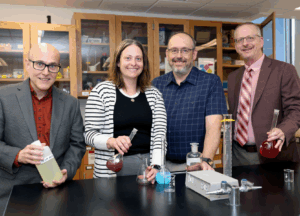
 For faculty members at the University of Nebraska at Kearney, supporting national defense doesn’t always mean wearing a uniform.
In classrooms, labs and research centers across campus, they’re contributing to the safety and security of the United States through the National Strategic Research Institute (NSRI) at the University of Nebraska.
Established in 2012, NSRI connects the Department of Defense and other federal agencies with experts from across the University of Nebraska System to address pressing threats and develop innovative solutions that keep Americans safe. It is one of only 15 DOD-designated University Affiliated Research Centers in the country and the only one sponsored by a unified combatant command – U.S. Strategic Command.
UNK faculty are among the roughly 200 researchers in the NSRI Academic Network, a collaboration that supports transdisciplinary projects in key areas such as chemical and biological defense, medical countermeasures, artificial intelligence, food security and strategic deterrence.
Each faculty member brings a unique perspective to the group, advancing NSRI’s mission while also opening doors for students and expanding the reach of UNK research.
That support and inspiration, she said, started with her sixth-grade science teacher, who sparked her love of DNA. Later, at Merck and Company, Dr. Sweasy was part of the team that developed Ivermectin, the drug farmers use to keep parasitic worms out of ruminant animals. She was especially impressed with how Merck’s then-CEO Roy Vagelos, MD, made the drug freely available to West Africans to eliminate river blindness.
CHEMISTRY THAT SAVES LIVES
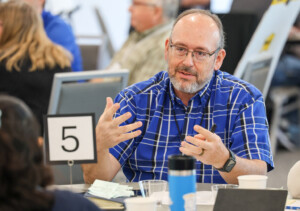 Scott Darveau, a chemistry professor and UNK’s director of research services, is among the newest members. But his involvement with NSRI predates his official designation.
From 2023 to 2024, he served as a co-investigator on a project in NSRI’s mission area funded through the University of Nebraska Collaboration Initiative. The project is aimed at creating a modified hydrogel for chemical decontamination.
The hydrogel – think slime – was engineered to neutralize and contain deadly chemical agents such as mustard gas or VX, which can linger on surfaces long after exposure. By incorporating powerful oxidizers, the research team reduced the time needed to destroy these agents from hours or days to minutes.
Darveau worked with researchers from the University of Nebraska-Lincoln and NSRI on the project. His role was to analyze the oxidizing agents using Raman microspectrometry, a technique that uses lasers to measure molecular vibrations and identify the chemical makeup of substances. His insights allowed the team to refine the gel’s composition, ultimately improving its effectiveness.
Once the decontamination process is complete, the hydrogel thickens and can be peeled away, restoring vehicles, equipment or buildings to safe use without causing additional damage.
“We are certain this formulation will likely also be effective against a number of biologic agents and are awaiting additional funding to continue our studies,” Darveau explained.
The project exemplifies the kind of fast, focused collaboration NSRI enables.
“By creating a close synergy between STRATCOM and NU, NSRI can quickly fulfill the needs of the Department of Defense while giving NU researchers a quick and efficient way to propose and receive funding for critically needed projects – about one-third the time it would typically take to get a federal grant through another channel,” Darveau said.
“Another major advantage of working in these research teams is that we can tackle problems that no one person has the expertise to handle alone,” he added. “We each bring a range of talents and disciplinary perspectives to a research plan in a way that finds novel solutions. The most interesting problems in science right now are ones that require large teams.”
FROM THE CLASSROOM TO WARGAMES
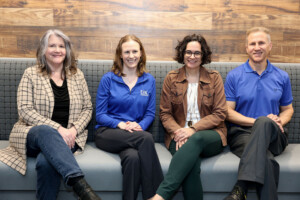 Psychology professor Krista Forrest brings a different but equally valuable lens to national defense – one grounded in human behavior.
Her research focuses on decision-making and group dynamics, topics with obvious implications for military operations and strategic planning. Forrest studies how individuals interact in high-pressure group settings, such as interrogations, jury deliberations and military decision-making teams. She’s particularly interested in how communication patterns and perceptions of fairness affect outcomes.
“Threats like chemical or nuclear attacks start and end with people,” she said. “Understanding how people work together – or don’t – can help us improve decisions that have national security implications.”
A member of the NSRI network since 2024, Forrest is also passionate about involving students in her work. She and undergraduate student Logan Muirhead recently presented research at the NSRI Fellows Conference – the first time a UNK student has done so. Muirhead, a pre-pharmacy student from Valentine, is exploring how different cognitive processing styles – holistic vs. analytic – impact decision-making in wargame scenarios.
Together, they’re designing a study to see whether pairing people with complementary approaches to problem-solving leads to better strategies and outcomes in complex tasks.
“I want students to see that their research can have real-world applications,” Forrest said. “And I want other faculty to know that curiosity doesn’t stop after tenure. It means a lot to me to be associated with NSRI because I have much to learn about the development of military strategy and the use of wargaming to teach that strategy. I am looking forward to having discussions with experts in the field who are working with our military.”
DEFENDING THE FOOD CHAIN
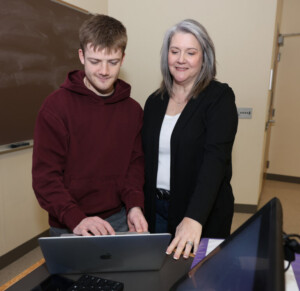 Jody Herchenbach, another recent addition to the NSRI Academic Network, approaches defense from the field. Literally.
An assistant professor of agribusiness and economics, Herchenbach grew up in a farming family. That background shapes her research interests, which focus on the agricultural industry and its role in national security.
“If agriculture is affected, our food supply and our entire economy are affected,” she said. “So protecting our farmers and ranchers is also protecting our country.”
Herchenbach is interested in exploring topics such as cybersecurity for rural producers and consumer perceptions of genetically engineered livestock. Though she hasn’t launched a formal NSRI project yet, she values the opportunity to collaborate with colleagues across NU and contribute to the defense of America’s food systems.
“NSRI makes it easier to find research partners and funding,” she said. “That kind of support is critical for moving ideas forward. This research allows us to be proactive, rather than reactive, in a variety of categories to ensure our safety as it relates to our health, well-being and economic viability.”
UNK’s collaboration with NSRI underscores the value of interdisciplinary collaboration. By combining their expertise in chemistry, psychology, agriculture and other fields, Loper faculty are helping the military address complex, real-world challenges.
And in doing so, they’re proving that research conducted on the plains of Nebraska can have a profound impact on the world stage.
– Originally posted by UNK NEWS on November 4, 2025. Written by Tyler Ellyson